RT080
RT080
RT080
RT080
RT080
RT080
RT080
RT080
RT080

RT080

Ruby 8 Tablet for Smarter Inventory & Payment

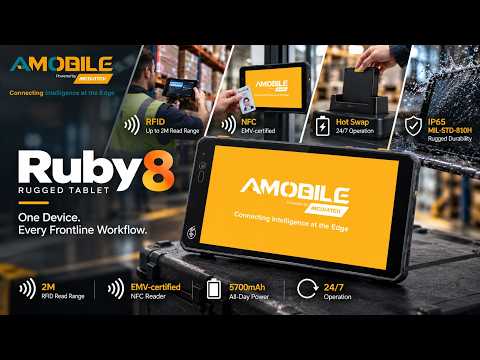
  • Dual data capture (RFID + Industrial 1D/2D barcode scanning)
  • Next-generation NFC on-screen payment and EMVCo Reduced Range 2 certification
  • Hot-swappable battery for uninterrupted 24/7 operation 
  • Powered by the MediaTek MT8781 octa-core processor, with Android 16 and a roadmap toward Android 18
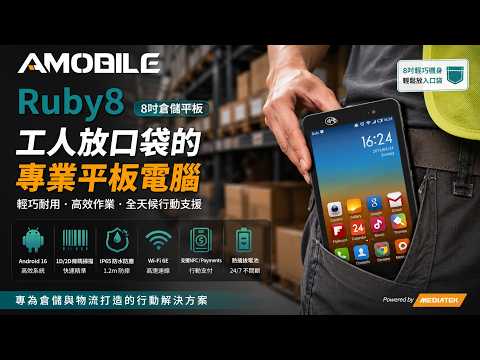
  • Compact 8-inch design for one-handed operation
  • 8" WXGA sunlight-readable IPS TFT LCD with 600 nits brightness. Multi-touch. Anti-glare. 
  • IP65-rated rugged design with 1.2 m drop resistance
  • WiFi 6E, WLAN, Bluetooth, and WWAN 3G, 4G LTE, 5G Redcap (optonal) connectivity for real-time logistics operations
RT080

The Ruby 8 Tablet is a rugged 8-inch mobile device designed to support RFID-enabled operations, mobile POS applications, and real-time field data capture. With its 8-inch display, Ruby 8 offers a compact and portable form factor that is easier to hold and operate with one hand compared with larger tablets, making it suitable for frontline workers who need to scan, check inventory, process transactions, or capture field data while moving through retail stores, warehouses, logistics facilities, and service environments.

RT080

Purpose-Built for Logistics Operations

Ruby 8 features a compact 8-inch design that fits easily into a cargo pocket while providing the screen size needed for comfortable one-handed operation. Integrating RFID, enterprise-grade barcode scanning, NFC, 4G LTE, 5G RedCap (optional), Wi-Fi, and Bluetooth, Ruby 8 enables inventory management, asset tracking, real-time data synchronization, and electronic proof of delivery (ePOD) on a single device.

With NFC-enabled SoftPOS support, delivery drivers can also accept contactless payments and Cash on Delivery (COD) directly at the customer's doorstep, eliminating the need for a separate payment terminal. Equipped with front and rear cameras, Ruby 8 also enables drivers to capture photos of delivery conditions, packages, or the delivery site, providing visual documentation to support proof of delivery and help resolve potential delivery disputes. Combined with its rugged design and long-lasting battery life, Ruby 8 helps frontline workers stay connected and productive across logistics, retail, and field service applications.

RT080

Powering Every Step of Warehouse Operations

Ruby 8 is purpose-built for WMS workflows, enabling warehouse teams to manage inventory, assets, and item-level operations with speed and accuracy. Its integrated RFID reader and enterprise 1D/2D barcode scanner provide flexible dual data capture for receiving, put-away, picking, packing, cycle counting, and shipping.

Built to withstand demanding warehouse environments, Ruby 8 features IP65 dust and water resistance, 1.2-meter drop protection, and MIL-STD-810H vibration and shock compliance.

With a 5,700 mAh main battery delivering more than 10 hours of operation and a backup battery that supports hot swapping without powering down, Ruby 8 keeps workers connected and productive throughout continuous warehouse operations.

RT080

Fast, Contactless Inventory Management with RFID

In warehouse operations, RFID enables fast, contactless, and batch inventory identification without requiring direct line-of-sight. It is particularly valuable when goods are stacked on pallets, stored in sealed cartons, placed on high shelves, or frequently moved throughout the warehouse. With a handheld RFID reader, workers can quickly scan multiple tagged items at once, significantly reducing the time and effort required for inventory counting while improving inventory visibility and accuracy.


Built for High-Efficiency RFID Inventory Workflows

Ruby 8 supports RFID-based inventory workflows for pallet and carton counting, high-value asset tracking, blind inventory checks, and automated inbound and outbound operations. Workers can read multiple RFID tags simultaneously—even when items are covered or difficult to access—making it ideal for high-frequency cycle counting and fast-moving warehouse environments. Combined with real-time connectivity, Ruby 8 helps WMS teams keep inventory data synchronized and up to date, improving operational efficiency and reducing discrepancies between physical stock and system records.

RT080

One Device. Ready for Every Field Mission

From facial recognition and driver fatigue monitoring to ID verification and real-time image capture, Ruby 8 gives field workers the tools they need to capture, verify, and share critical information wherever work takes place.

Its rugged design, featuring IP65 dust and water resistance, 1.2-meter drop protection, and MIL-STD-810H vibration and shock compliance, ensures reliable operation in demanding environments. Whether deployed in transportation, public safety, inspections, or field service, Ruby 8 keeps frontline teams connected, informed, and ready for action.

A Versatile Smart Retail Hardware Investment

A single tablet fully handles mobile POS, order reception, contactless NFC payments, and warehouse inventory management, significantly saving on the space and budget required for multiple single-function devices. Featuring on-screen contactless payment capabilities and EMVCo Reduced Range 2 certification, it offers staff and customers a secure, fast, and seamless mobile payment experience with comprehensive sensing coverage.

The device supports 24/7 non-stop operation via a hot-swappable battery design; it combines a high-capacity 5700mAh main battery (providing over 10 hours of runtime) with a secondary battery to enable hot-swapping without powering down. This allows frontline staff to replace batteries without interrupting applications or rebooting, completely eliminating the risk of business disruption due to power loss.

RT080
System
CPU MediaTek MT8781 Octa-core Processor
(2x Cortex A76 2.2GHz / 6x Cortex A55 2.0GHz)
Operating System Preloaded with Android 16, with seamless upgrade support to
Android 18.
Memory 4GB / 8GB (LPDDR4X)
Storage microSD card slot (supports up to 512GB)
Optional Storage  
LCD Display
Size / Type 8-inch IPS TFT LCD
Resolution 800 x 1280 (WXGA)
Brightness (cd/m2) 600 cd/m² (Typ.)
Touchscreen Projected capacitive multi-touch, Corning Glass,
anti-glare
Peripherals & Devices
Camera Front: 8MP
Rear: 13MP AF autofocus with LED flash
Sensors Accelerometer (G-sensor), digital compass,
gyroscope, ambient light sensor
GNSS AGPS / GPS / GLONASS / BeiDou / Galileo
Barcode Scanner SE4710 1D/2D barcode scanner
Audio & Vibration 2 x built-in microphones
1 x built-in speaker (2W)
1 x vibrator
OTG Supported
Wireless Communications
Wi-Fi Wi-Fi 6E
Bluetooth BT 5.4
WWAN 3G: Bands 1/2/5/8, HSDPA/HSUPA/HSPA+
4G: Bands 1/2/3/4/5/7/8/12/20/26/28/34/38/39/41
Telit LTE: LE910C4 (optional)
Telit 5G: 5G RedCap FE910C04 (optional)
NFC Supported (ISO/IEC14443A/B;
ISO/IEC15693; Tags 2/3/4/5)
RFID Read range: TBD    Read speed: TBD tags/s
I/O Interfaces
USB Port USB 2.0 Type-C
I/O USB Type-C x1 (USB 2.0 OTG),
Nano SIM x1, microSD slot x1, eSIM x1 (optional)
Buttons Trigger key, Volume +/-, Power key
Certifications
Product Certifications CE, FCC, NCC, JRF, JATE
Payment Certification EMVCo Reduced Range 2
Rugged Features
IP65-rated dust and water resistance
1.2 m (4 ft) drop resistance
Power
Charging USB Type-C, Pogo Pin (fast charging)
Power Input 9V/2A (fast charging) or 5V/3A, supports PD2.0 / PE2.0
Battery Capacity 5700mAh, battery life >10 hours; user-replaceable;
backup battery supports Hot Swap
Buttons
Physical Buttons Volume keys, barcode scan trigger key, power key
Mechanical & Environmental Specifications
Operating Temperature -10°C ~ 50°C (14°F ~ 122°F)
Storage Temperature -30°C ~ 70°C (-22°F ~ 158°F)
Shock & Vibration MIL-STD-810H, 514.8C-3
Relative Humidity Operating: 5% ~ 90% RH, non-condensing;
Storage: 5% ~ 95% RH
Dimensions 210.0 x 126.5 x 12.3 mm
Weight < 500g (1.49lb)
Accessories
Accessories Charging dock, hand strap
 
Applications
Smart Retail & Hospitality Retail inventory counting, mobile checkout in large-format stores, tableside ordering and on-screen contactless payment, and mobile payment collection at pop-up stores and markets.
Logistics & Asset Management Warehouse inventory counting, cross-zone RFID batch asset tracking, e-commerce barcode scanning, outdoor delivery confirmation, and electronic proof of delivery (ePOD).
Field Service & Public Safety Roadside citation issuance, patrol inspections, outdoor parking fee collection, field data recording, and mobile public-service operations.
Manufacturing & Inspection Production-line data collection, RFID tracking of raw materials and work-in-process, barcode verification, and routine inspection of industrial equipment or public infrastructure.
Healthcare Mobile access to patient data, barcode-based medication verification, RFID management of controlled medications and medical assets, and bedside or ward-based mobile workflows.
Transportation & In-Vehicle Services Mobile ticketing and validation, in-vehicle retail payment, crew services, barcode/ticket verification, and real-time data transmission in mobile environments.
 
Frequently Asked Questions (FAQ)
Q1: How can retail and logistics companies reduce the number of mobile devices frontline workers need to carry? Retail and logistics companies can consolidate inventory counting, barcode scanning, RFID reading, identity verification, mobile payment, and proof of delivery into a single rugged mobile device. An integrated platform can reduce the need for separate barcode scanners, RFID readers, payment terminals, and tablets, helping lower hardware costs, simplify device management, and improve frontline workflow efficiency. Ruby 8 uses an all-in-one design that integrates RFID, 1D/2D barcode scanning, NFC, wireless connectivity, and mobile computing into a single 8-inch platform.
Q2: When is RFID more suitable than barcode scanning for warehouse inventory management? RFID is particularly suitable when a warehouse needs fast, non-line-of-sight, or high-volume batch inventory counting. Workers do not need to align with individual barcodes and can identify multiple RFID-tagged products, cartons, or assets at once. Barcode scanning is better suited to workflows that require precise item-level verification. By combining RFID and barcodes, companies can use RFID for rapid bulk inventory counting and barcodes for item-level verification during receiving, picking, packing, and shipping.
Q3: Can a single mobile device support the complete workflow from warehouse inventory and delivery to customer payment? Yes. Modern enterprise mobile devices can support end-to-end logistics workflows, beginning with RFID inventory counting and barcode-based picking in the warehouse, followed by real-time data synchronization over mobile networks or Wi-Fi during transport. At the customer site, workers can capture electronic proof of delivery (ePOD) and complete cash-on-delivery (COD) transactions through NFC contactless payment. This allows logistics operators to perform multiple delivery tasks with a single device.
Q4: What factors should companies consider when choosing a rugged mobile device for retail, logistics, and field operations? Key evaluation criteria include ruggedness, battery life, hot-swap capability, operating-system lifecycle, wireless connectivity, barcode and RFID data capture, NFC/payment functionality, display visibility, operating temperature, and device size and weight. Companies should also evaluate whether a single device can support multiple workflows, because functional integration can help reduce equipment costs, training requirements, maintenance complexity, and the number of devices frontline workers need to carry.
Q5: How can mobile technology improve ROI and productivity in retail and logistics operations? Mobile technology can improve return on investment by reducing manual inventory work, shortening transaction and delivery times, improving inventory accuracy, and consolidating multiple dedicated devices into a single platform. In high-volume environments, capabilities such as RFID batch reading, enterprise-grade barcode scanning, real-time wireless data synchronization, mobile payment, and electronic proof of delivery (ePOD) can reduce repetitive tasks and allow frontline workers to complete more work without frequently returning to a fixed workstation.
Q6: Can an all-in-one rugged tablet reduce total cost of ownership (TCO) compared with using separate RFID readers, barcode scanners, and payment terminals? Yes. Integrating RFID, barcode scanning, NFC payment, wireless connectivity, and mobile computing into a single rugged device can reduce the number of devices a company needs to purchase, deploy, charge, maintain, and replace. It can also simplify employee training, spare-device management, software deployment, and mobile device management (MDM). For retail, logistics, and field-service operators, an all-in-one platform can help lower total cost of ownership (TCO) while simplifying frontline workflows.
Q7: What key specifications should enterprises prioritize when selecting an EMVCo-compliant Android mobile payment tablet? When selecting a mobile payment tablet, enterprises should prioritize security certifications, system lifecycle, all-day operational continuity, and all-in-one asset-management capabilities. Using the AMOBILE RT080 (Ruby8) smart payment tablet as an example:

1. International payment certification and on-screen contactless payment: RT080 supports intuitive NFC on-screen contactless payment and is expected to obtain EMVCo Reduced Range 2 certification, helping ensure secure and smooth mobile acceptance and SoftPOS applications.

2. Extended system lifecycle: Preloaded with Android 16 and designed to support seamless upgrades to Android 18, with GMS (EDLA) certification, RT080 can extend the useful lifecycle of enterprise software assets and help reduce long-term maintenance costs.

3. Dual identification and 24/7 operational continuity: Built-in RFID tag reading and an industrial-grade SE4710 1D/2D barcode scanner are combined with a 5700mAh hot-swappable battery system, allowing frontline workers to replace the battery without shutting down the device and maintain uninterrupted inventory and checkout operations around the clock.
Q8: How can a rugged tablet with RFID and barcode scanning optimize all-in-one workflows across retail, warehousing, and logistics? In modern retail, warehousing, and logistics operations, a rugged tablet that integrates RFID, professional-grade scanning, and mobile payment acceptance—such as the AMOBILE RT080—can replace multiple single-purpose devices and streamline workflows into three core steps:

1. Efficient asset inventory (RFID): With built-in RFID capability, warehouse staff can perform wide-area and cross-zone batch reading of tagged products and work-in-process items without aligning each tag individually, significantly improving inventory-counting efficiency.

2. Accurate price lookup and item verification (barcode scanning): For conventional barcodes, frontline workers can use RT080's built-in industrial-grade SE4710 1D/2D scanner for real-time price lookup and shipping verification. Its IP65-rated dust and water resistance and 1.2-meter drop protection make it suitable for demanding warehouse environments.

3. Mobile checkout and fleet management (next-generation connectivity): With Wi-Fi 6E and 5G RedCap wireless connectivity, RT080 can support high-bandwidth, low-latency data transmission for applications ranging from tableside ordering and on-screen contactless SoftPOS payment at pop-up stores to cross-region logistics fleet management.


  • Name
  • Type
  • Size
  • Language
  • Version
  • Publish date
  • RT080
    PDF
    638 KB
    En
    1.1
    2026-08-11
Go Back