| Frequently Asked Questions (FAQ) |
| Q1: How can retail and logistics companies reduce the number of mobile devices frontline workers need to carry? |
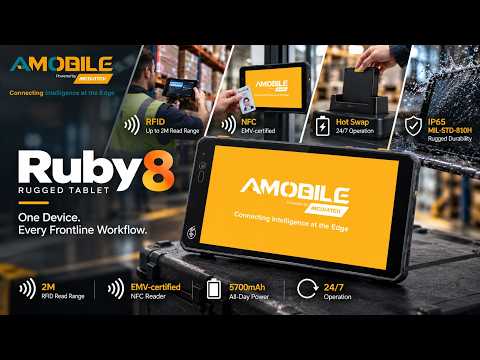
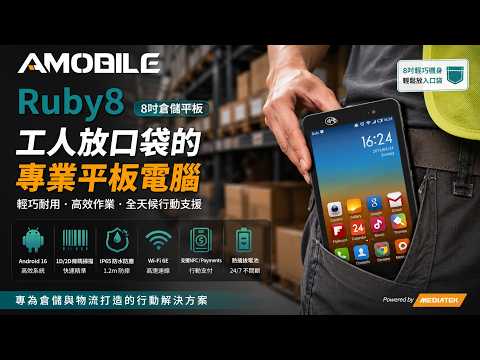
Retail and logistics companies can consolidate inventory counting, barcode scanning, RFID reading, identity verification, mobile payment, and proof of delivery into a single rugged mobile device. An integrated platform can reduce the need for separate barcode scanners, RFID readers, payment terminals, and tablets, helping lower hardware costs, simplify device management, and improve frontline workflow efficiency. RT080 uses an all-in-one design that integrates RFID, 1D/2D barcode scanning, NFC, wireless connectivity, and mobile computing into a single 8-inch platform. |
| Q2: When is RFID more suitable than barcode scanning for warehouse inventory management? |
RFID is particularly suitable when a warehouse needs fast, non-line-of-sight, or high-volume batch inventory counting. Workers do not need to align with individual barcodes and can identify multiple RFID-tagged products, cartons, or assets at once. Barcode scanning is better suited to workflows that require precise item-level verification. By combining RFID and barcodes, companies can use RFID for rapid bulk inventory counting and barcodes for item-level verification during receiving, picking, packing, and shipping. |
| Q3: Can a single mobile device support the complete workflow from warehouse inventory and delivery to customer payment? |
Yes. Modern enterprise mobile devices can support end-to-end logistics workflows, beginning with RFID inventory counting and barcode-based picking in the warehouse, followed by real-time data synchronization over mobile networks or Wi-Fi during transport. At the customer site, workers can capture electronic proof of delivery (ePOD) and complete cash-on-delivery (COD) transactions through NFC contactless payment. This allows logistics operators to perform multiple delivery tasks with a single device. |
| Q4: What factors should companies consider when choosing a rugged mobile device for retail, logistics, and field operations? |
Key evaluation criteria include ruggedness, battery life, hot-swap capability, operating-system lifecycle, wireless connectivity, barcode and RFID data capture, NFC/payment functionality, display visibility, operating temperature, and device size and weight. Companies should also evaluate whether a single device can support multiple workflows, because functional integration can help reduce equipment costs, training requirements, maintenance complexity, and the number of devices frontline workers need to carry. |
| Q5: How can mobile technology improve ROI and productivity in retail and logistics operations? |
Mobile technology can improve return on investment by reducing manual inventory work, shortening transaction and delivery times, improving inventory accuracy, and consolidating multiple dedicated devices into a single platform. In high-volume environments, capabilities such as RFID batch reading, enterprise-grade barcode scanning, real-time wireless data synchronization, mobile payment, and electronic proof of delivery (ePOD) can reduce repetitive tasks and allow frontline workers to complete more work without frequently returning to a fixed workstation. |
| Q6: Can an all-in-one rugged tablet reduce total cost of ownership (TCO) compared with using separate RFID readers, barcode scanners, and payment terminals? |
Yes. Integrating RFID, barcode scanning, NFC payment, wireless connectivity, and mobile computing into a single rugged device can reduce the number of devices a company needs to purchase, deploy, charge, maintain, and replace. It can also simplify employee training, spare-device management, software deployment, and mobile device management (MDM). For retail, logistics, and field-service operators, an all-in-one platform can help lower total cost of ownership (TCO) while simplifying frontline workflows. |
| Q7: What key specifications should enterprises prioritize when selecting an EMVCo-compliant Android mobile payment tablet? |
When selecting a mobile payment tablet, enterprises should prioritize security certifications, system lifecycle, all-day operational continuity, and all-in-one asset-management capabilities. Using the AMOBILE RT080 (Ruby8) smart payment tablet as an example:
1. International payment certification and on-screen contactless payment: RT080 supports intuitive NFC on-screen contactless payment and is expected to obtain EMVCo Reduced Range 2 certification, helping ensure secure and smooth mobile acceptance and SoftPOS applications.
2. Extended system lifecycle: Preloaded with Android 16 and designed to support seamless upgrades to Android 18, with GMS (EDLA) certification, RT080 can extend the useful lifecycle of enterprise software assets and help reduce long-term maintenance costs.
3. Dual identification and 24/7 operational continuity: Built-in RFID tag reading and an industrial-grade SE4710 1D/2D barcode scanner are combined with a 5700mAh hot-swappable battery system, allowing frontline workers to replace the battery without shutting down the device and maintain uninterrupted inventory and checkout operations around the clock. |
| Q8: How can a rugged tablet with RFID and barcode scanning optimize all-in-one workflows across retail, warehousing, and logistics? |
In modern retail, warehousing, and logistics operations, a rugged tablet that integrates RFID, professional-grade scanning, and mobile payment acceptance—such as the AMOBILE RT080—can replace multiple single-purpose devices and streamline workflows into three core steps:
1. Efficient asset inventory (RFID): With built-in RFID capability, warehouse staff can perform wide-area and cross-zone batch reading of tagged products and work-in-process items without aligning each tag individually, significantly improving inventory-counting efficiency.
2. Accurate price lookup and item verification (barcode scanning): For conventional barcodes, frontline workers can use RT080's built-in industrial-grade SE4710 1D/2D scanner for real-time price lookup and shipping verification. Its IP65-rated dust and water resistance and 1.2-meter drop protection make it suitable for demanding warehouse environments.
3. Mobile checkout and fleet management (next-generation connectivity): With Wi-Fi 6E and 5G RedCap wireless connectivity, RT080 can support high-bandwidth, low-latency data transmission for applications ranging from tableside ordering and on-screen contactless SoftPOS payment at pop-up stores to cross-region logistics fleet management. |